Business Glossary as Low Maturity
Extracted from the public Notion original. Notion record created 2019-07-24. Last edited 2019-07-24.
Under the overall Enterprise Data Architecture Meta-model the component called “Business Meaning, Measures, and Metrics” always generates discussion.
Many IT teams and software vendors use the short-hand of “Business Glossary” when describing this component. This is insufficient for a business-driven enterprise information management function.
While the existence of a well maintained “Business Glossary” is an important aspect of establishing this component of the data architecture, it is fundamentally a low maturity version of the capability. A business glossary will quickly become an “ideal realised strategy” (1) unless a full understanding of this component is established.
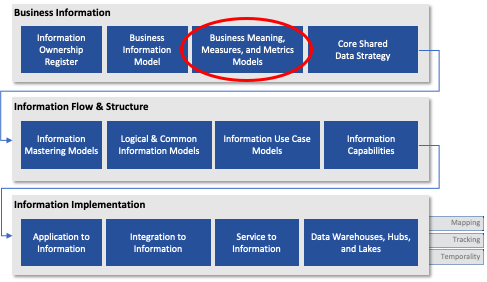
The definition of this component is as follows:
“Business meaning, measures, and metrics models can come in many forms; including business glossaries, metrics plans, business process measures, performance management strategies, and business intelligence strategies.” (2)
More importantly the maturity of the component can be defined as follows:
- Level 0 - No formal management of definitions.
- Level 1 - Business Glossary artefacts formally maintained.
- Level 2 - Understanding that Business Glossary terms are part of data domains, aligned to data ownership approaches. Efforts to ensure definitions are available in the context of data entry and report interpretation business processes.
- Level 3 - There is upwards and downwards context for each business glossary term, and the glossary term is mastered in its upwards context. This means the authoritative source for the definition of a measure or metric is the performance management strategy that the measure or metric relates to.
- Level 4 - An approach based on the principles of "Integrated Performance Management” incorporates the measures and metrics. This includes both how executive measures are supported by management and operational measures; as well as how measures and metrics relate to one another to influence the overall performance of the organisation.
- Level 5 - There is deep understanding of of how and when (i.e. lag versus lead) changes in measures and metrics impact organisational performance, how accuracy / data quality impacts performance, and the impact of this on planning the portfolio of initiatives to improve organisational performance.
Notes:
(1) The concept of an “ideal realised strategy” is part of the MWT Model. It is a strategy that only works if it is executed perfectly but for which no executive attention is devoted to managing against the strategy. Typically “ideal realised strategies” are used as organisational excuses post hoc. e.g. “This happened because you didn’t forward me that email. I said forward me all relevant emails”.
(2) This definition follows the concept of "tautological simplification” as per the MWT Model. The concept follows from the idea that simplification is context specific. If no context is given the default style of simplification should be tautological in that it incorporates terms of other contextual domains that are also undefined. eg. “The definition of a business capability is the labels that the execution team give to specific capabilities in the organisation when they discuss strategy, executive accountability, and the implementation of strategy”.