Enterprise Information Model Blueprint
Extracted from the public Notion original. Notion record created 2019-07-24. Last edited 2025-11-18.
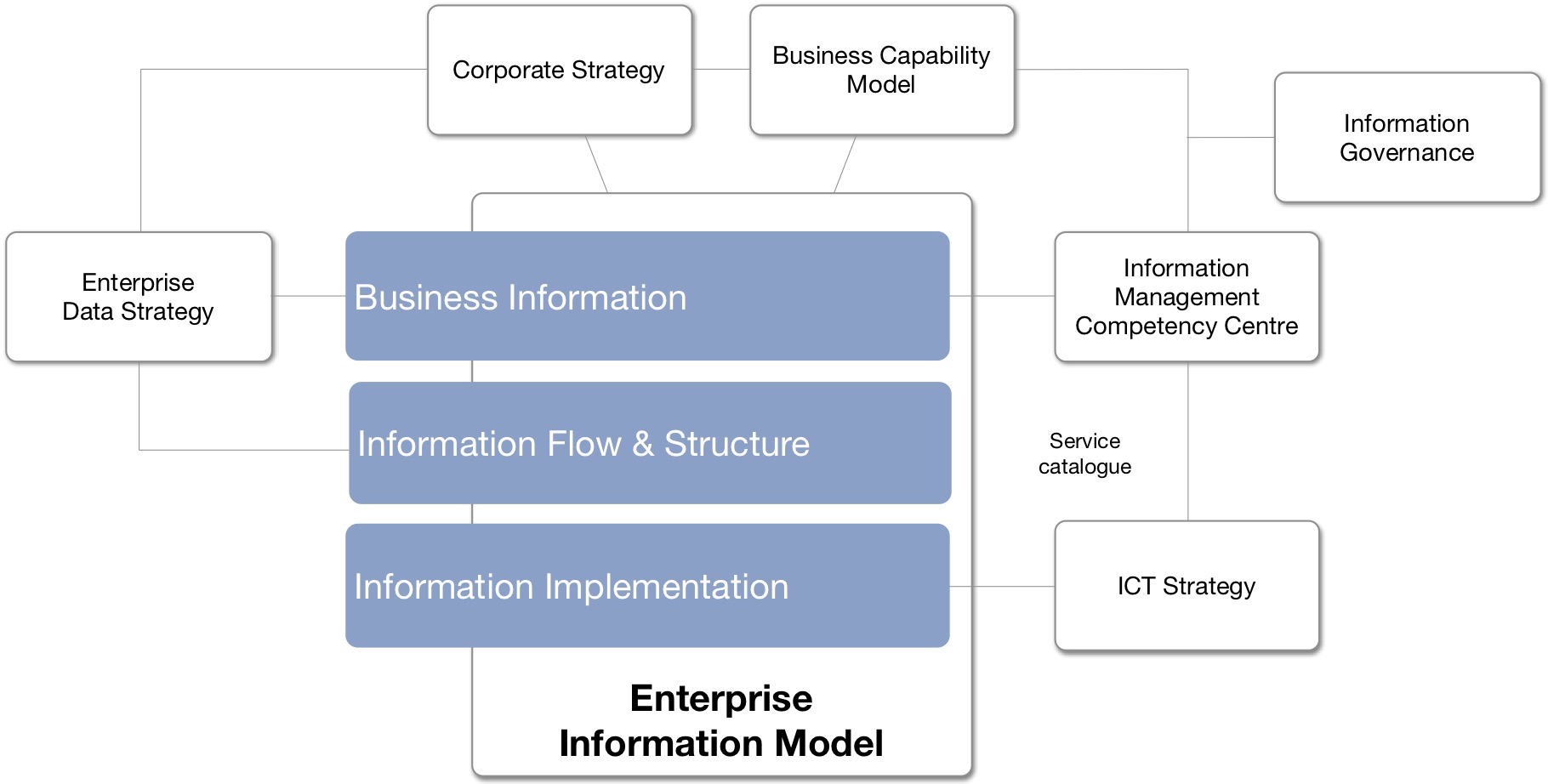
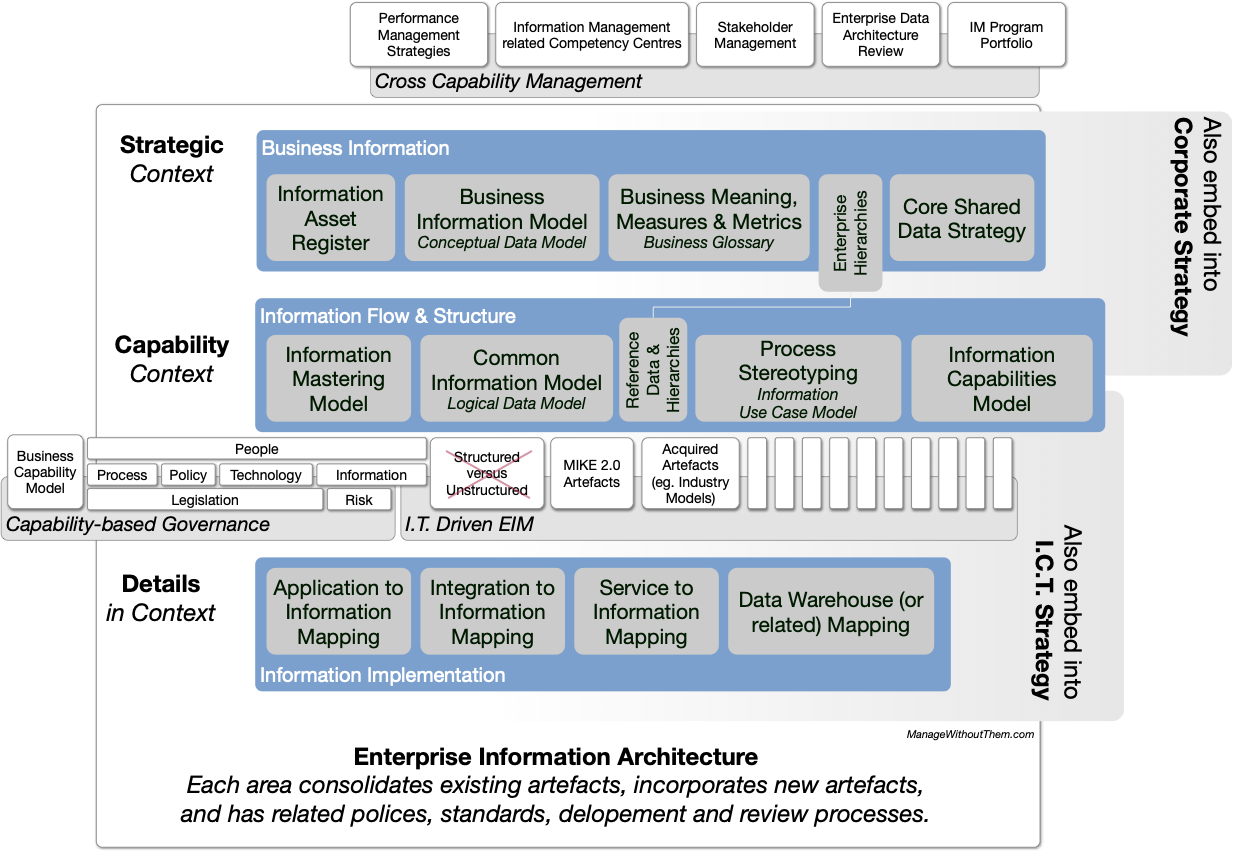
The Enterprise Information Model (EIM) is a view of the information in an organisation, where it’s stored, how it flows, and its structure. See also Why is a Enterprise Information Model important?
Simple View
Complete View
What information does your organisation have?
The job of meta-data management is to ensure you know about your data & information - but it's just so... meta. The idea is that we need to recognise that there needs to be a shared understanding of how we catalogue all the data / information your organisation has and how it's used.
Banging on about meta-data management for months isn't going to create this shared understanding. Either you've done the work to create a shared understanding or you haven't. This blueprint will have you get started in that effort:
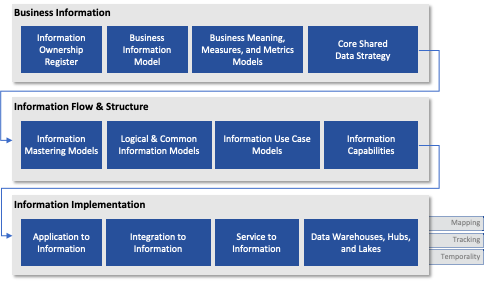
Layers
It's important that this isn't a "technical view", nor is it a "business view". The idea isn't to split our understanding of our data / information into two separate categories. The idea is to create a shared understanding of our data & information. This is a very different approach.
Business Information
This layer defines how stakeholders talk about, think about, and prioritise the organisation's information
Information Structure & Flow
This layer defines how information moves around the organisation; including where it's used and how it's structured
Information Implementation
This layer contains mappings to IT systems and specialised approaches to tracking information as it moves and changes over time (if they have been implemented)
Individual Components
Business Information
- Brief Description
- List of owners / stewards / SMEs - based on Data Governance Framework & Ownership Model
- Component
- Information Ownership Register
Business Information Model
- Brief Description
- The data landscape and minimal model(s) required to apply data governance down to data owner level
- Component
- Business Information Model
Business Meaning, Measures, and Metrics Models
- Brief Description
- Broad common definitions required to operate the business effectively; both common language and common measurement of key capabilities, life-cycles, and against business performance strategies
- Component
- Business Meaning, Measures, and Metrics Models
Core Shared Data Strategy
- Brief Description
- Executive agreement and commitment to managing specific data domains across business unit boundaries; including commitment to cost sharing and additional effort required to maximise the value of those information assets to all stakeholders
- Component
- Core Shared Data Strategy
Information Flow & Structure
- Brief Description
- Terms of reference and target approaches to mastering key information assets; including impacts on process, culture, data integration, and application landscape
- Component
- Information Mastering Models
Logical & Common Information Models
- Brief Description
- Attribute level models which describe the structure of data in multiple contexts; including entities in a data domain, canonical models for mastering, or data required to execute a defined business process
- Component
- Logical & Common Information Models
Information Use Case Models
- Brief Description
- Integration with business process efforts; either where they are explicitly managed under process excellence frameworks or where information management models must compensate for the absence of process-based disciplines
- Component
- Information Use Case Models
Information Capabilities
- Brief Description
- Integration with Business Capability Modelling efforts; including traceability to business capabilities, extensions to capability-based governance, and pooling of capabilities that have been incorrectly split
- Component
- Information Capabilities
Information Implementation
- Brief Description
- Linking Data Domains, and Critical Data Elements, to the IT Configuration Management Database (CMDB)
- Component
- Application to Information
* Mapping
* Tracking
* Temporality
Integration to Information * Mapping * Tracking * Temporality
- Brief Description
- Linking Data Domains, and Critical Data Elements, to the IT Configuration Management Database (CMDB)
- Component
- Integration to Information
* Mapping
* Tracking
* Temporality
Service to Information * Mapping * Tracking * Temporality
- Brief Description
- Linking Data Domains, and Critical Data Elements, to the IT Configuration Management Database (CMDB)
- Component
- Service to Information
* Mapping
* Tracking
* Temporality
Data Warehouses, Hubs, and Lakes to Information * Mapping * Tracking * Temporality
- Brief Description
- Linking Data Domains, and Critical Data Elements, to the IT Configuration Management Database (CMDB)
- Component
- Data Warehouses, Hubs, and Lakes to Information
* Mapping
* Tracking
* Temporality
Notes on the Information Implementation Layer
Each of the components of the information implementation layer looks similar. This is because we want to generalise this layer so it works in contexts like "data lineage" management.
When the distinction is made between Mapping, Tracking, and Temporality it means the following:
- Mapping - what data is stored or transmitted in each area (as meta data)
- Tracking - the ability to track where a specific piece of data (not as meta data but an actual instance of a specific data value) has traveled
- Temporality - the ability to be able to know what the value of a specific piece of data was at a specific time