Limited, by Critical Role of Data Governance in Strategy Deployment
Extracted from the public Notion original. Notion record created 2019-06-19. Last edited 2019-06-19.
If we imagine a hierarchy of services we might build up through the followIng stack:
- Foundational application services that ensure software systems are running; with performance, availability, and change control top of mind
- The recent and topical concept of data-as-a-service that separates the data from the systems and processes that created it - to make it easier to put that data to use in other contexts
- The vast range of information services that we’ve called business intelligence, analytics, data science - re-cutting and expanding definitions as we mature our thinking
- A structured understanding of what our organisations actually do - separate from how it’s done - so we make strategic decisions about what we need more or less of and the gaps. This is best labelled business capabilities and so encompassing it’s best not to think of it as just a type of service
The diagram below is a summary of how these layers might be managed and where data governance fits.
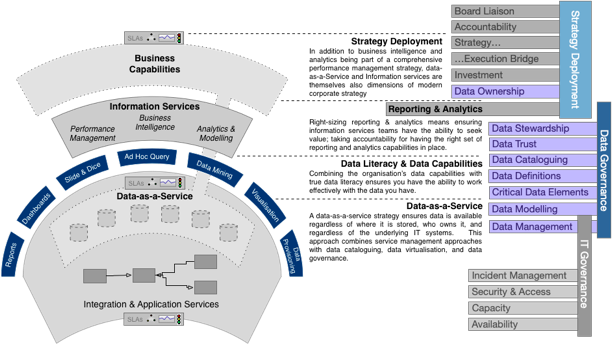
In this view of an organisation, Data Governance has a peculiar role sitting between IT Governance and what I’d call Strategy Deployment.
To those involved in IT Governance and IT Delivery it would seem that the data governance function, and the appointment of data owners, externalises a bunch of accountabilities IT departments have always thought were the responsibility of “the business” anyway.
This often becomes a deadlock where business units thing IT isn’t managing data well and IT departments insist “isn’t that your job?”
But the integration of data governance and IT governance isn’t where you should focus your efforts. This problem will resolve itself more naturally if you focus on the integration of data governance and strategy deployment.